

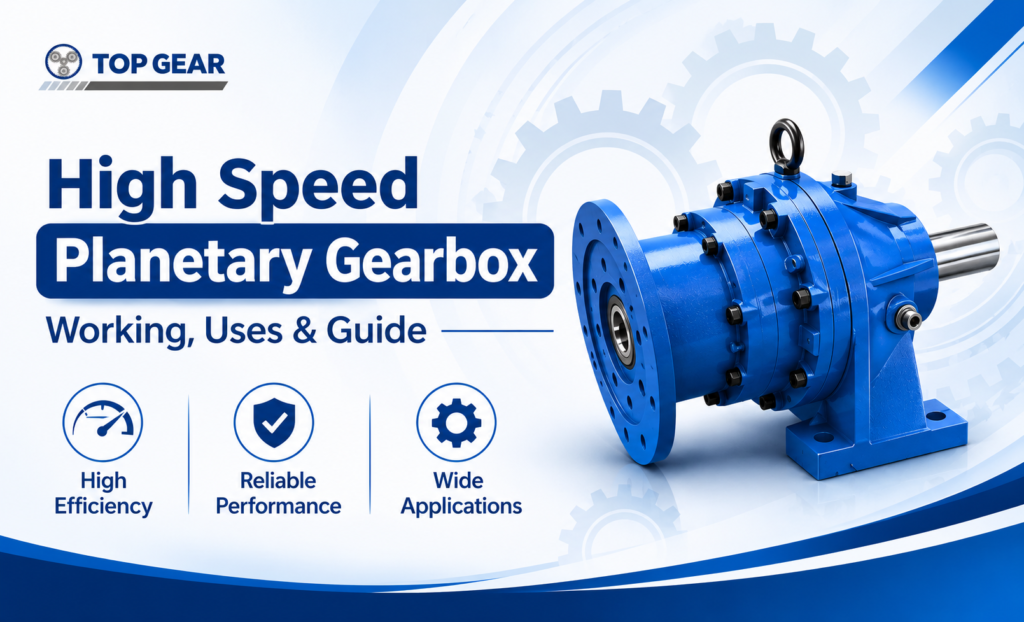
Most gearbox selections begin with torque. When the input shaft turns fast, a different question comes first: what happens to the gears, bearings and oil at that speed? A high speed planetary gearbox has to answer that question as well as deliver the required reduction in a compact space. This guide explains how planetary gearing works, what “high speed” really implies, and what to check before choosing one.
What a planetary gearbox is
A planetary gearbox has a sun gear at the centre, several planet gears meshing around it, a carrier holding the planets, and a ring gear with internal teeth surrounding everything. In a common reduction arrangement the motor drives the sun gear, the ring gear is held fixed, and the output is taken from the carrier. Other arrangements exist, such as a fixed carrier or a driven ring gear, and they give different ratios and directions of rotation.
How it differs from a parallel-shaft gearbox
In a parallel-shaft or helical gearbox, input and output shafts sit side by side on offset axes and each gear mesh carries the full torque. In a planetary gearbox, input and output are coaxial and torque is divided among the planets. This gives a compact, in-line package with a high torque-to-size ratio. The trade-offs are a larger number of precision parts, more bearings and a more demanding lubrication design. Top Gear Corporation also lists a parallel shaft and bevel helical gearbox range, which is the usual comparison when offset shafts are acceptable.
How planetary gearing shares the load
Because several planets mesh with the sun and ring at once, each tooth contact carries only a fraction of the torque. The radial forces on the sun gear largely cancel, which reduces the bearing load on the input side. This benefit depends on how evenly the planets share the load, which is a function of manufacturing accuracy, carrier stiffness and the way the planets are located. It is a good question to put to any manufacturer.
What “high speed” means
There is no universal definition. Speed is relative to the size and design of the gearbox. A rotational speed that is routine for a small frame may be demanding for a large one, because gear pitch-line velocity, bearing speed and the centrifugal effects on the planets all rise with size and speed. For that reason, do not judge a unit by a single speed figure. Ask the manufacturer for the permitted input speed for the specific frame size, ratio and lubrication method, and compare it with the actual speed of your motor or prime mover.
Features to evaluate
- Gear accuracy and finish: precise tooth form lowers noise, vibration and heat at speed.
- Planet and input bearings: their type, life calculation and speed rating.
- Carrier rigidity and balance: affects load sharing and smooth running.
- Lubrication design: splash, forced circulation or cooling, and what the design assumes about orientation.
- Housing and sealing: stiffness, oil retention and breathing at temperature.
- Backlash: relevant only if positioning accuracy matters.
- Mechanical and thermal ratings: both should be stated, since a unit can pass one and fail the other.
Torque, speed and ratio
Output torque is roughly input torque multiplied by the ratio and by the efficiency. A fast input with a large ratio gives low output speed and high torque, so check the output shaft and the connected equipment as well as the gearbox. Peak and starting torque matter, not just running torque. Load inertia seen at the motor falls with the square of the ratio, which is why gearboxes help with inertia matching in automation drives.
Efficiency and heat
Gear mesh, bearings, seals and oil churning all turn power into heat. At high input speed, churning and bearing losses grow, so thermal capacity can limit the unit before mechanical strength does. If the gearbox runs hot, the oil degrades faster and the seals suffer. Ask for the thermal rating at your speed and ambient temperature, and whether cooling or an oil circulation system is needed. Do not rely on a general efficiency percentage.
Typical applications
Planetary units are considered where a fast motor needs a compact reduction on the same axis: industrial automation drives, process machinery, mixing and agitating equipment and geared-motor assemblies. Top Gear Corporation describes its planetary gearbox range as modular, with foot, flange and shaft mounting options, and also offers planetary geared motors and servo planetary gear reducers. Whether a particular model suits high input speeds should be confirmed with the company, as no speed capability is assumed here. The industrial automation page shows the context in which compact, accurate drives are used.
Lubrication, installation and maintenance
Use the lubricant grade and quantity the manufacturer specifies, and check the level with the unit in its working orientation. Align the motor and gearbox carefully, and use a coupling rated for the speed. Run the unit in as recommended, then monitor temperature, noise and vibration. Oil analysis and scheduled changes catch wear early. Keep breathers clear, because a blocked breather raises internal pressure and pushes oil past seals.
Selecting a gearbox and what to ask the manufacturer
Work through the selection in this order: define the input speed and power, the required output speed or ratio, peak torque, duty hours, mounting position, ambient temperature and connected equipment. Then ask:
- What is the permitted input speed for this frame and ratio?
- What are the mechanical and thermal ratings at my speed?
- How is the unit lubricated and cooled in my mounting orientation?
- What service factor was applied?
- What testing is done before dispatch?
Top Gear Corporation also publishes a calculator page and a product brochure that list its range. For a planetary design that mounts directly on a driven shaft, see the shaft mounted planetary gearbox page.