
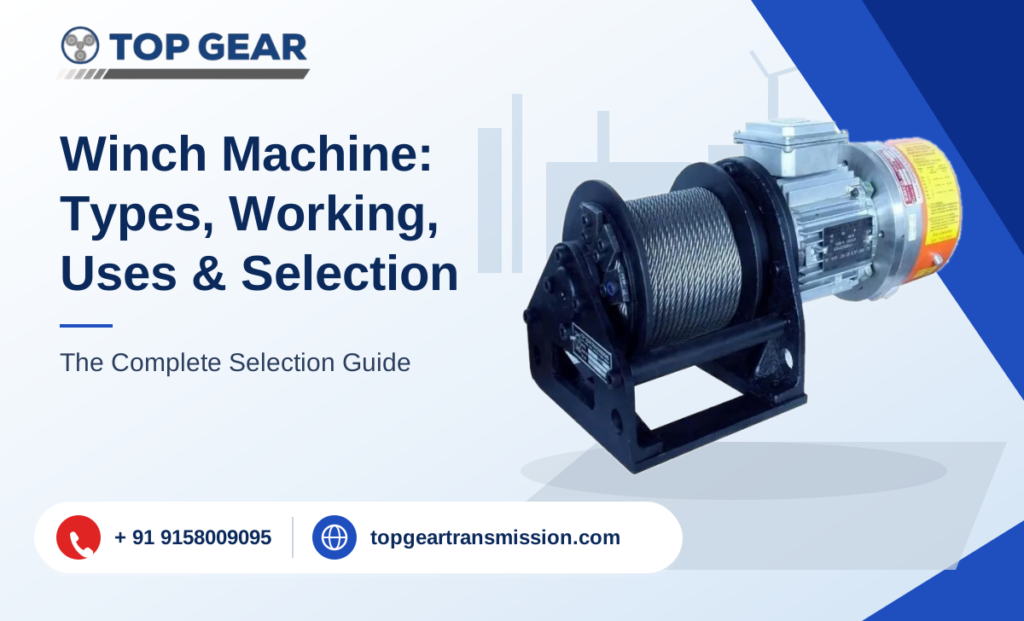
A winch machine is one of the oldest mechanical aids still in daily industrial use, and the basic idea has not changed: a drum winds a rope to move a load. What has changed is the range of designs built around that idea. Knowing the parts and how they interact makes it easier to read a specification and to explain a requirement to a manufacturer.
What a winch machine does and how it works
A winch machine winds rope, cable or chain onto a drum to pull, lift, lower or hold a load. A power source turns a gear train, the gear train reduces speed and multiplies torque, and the output turns the drum. The pull in the rope is the drum torque divided by the effective drum radius, which is why gear ratio and drum diameter must be considered together. A brake holds the load when power is removed.
Main components
- Prime mover: an electric, hydraulic or air motor, or an engine.
- Gearbox: reduces speed and raises torque. Planetary, helical and worm arrangements are all used.
- Drum: stores the rope. Its diameter, length and flange height govern capacity and rope layers.
- Rope or cable: carries the load and must match the drum and sheaves.
- Brake: holds the load and stops the drum.
- Frame and controls: carry the reaction forces and provide start, stop and direction, plus protective devices such as limit switches and overload protection.
Power flows from the motor through the gearbox to the drum, then through the rope to the load. The weakest link sets the real capacity of the machine.
Common types
By power source
- Electric: suited to locations with a reliable power supply and repeated duty.
- Hydraulic: driven by a hydraulic motor from a power pack or a machine’s hydraulic system; common on mobile and heavy equipment. Top Gear Corporation’s article on winch drives for heavy load applications covers hydraulic and electric options.
- Pneumatic: driven by compressed air, used where electric equipment is undesirable.
- Manual: hand-cranked, for light and occasional duty.
By drum and rope arrangement
- Single drum: one rope on one drum, the most common arrangement.
- Double drum: two independent drums for two ropes on one machine.
- Capstan or friction type: the rope passes around a rotating head and is handled at the tail, so no rope is stored on a drum. It suits long hauls.
By function
Pulling, hoisting, towing and mooring winches share the same basic parts but differ in duty and safety devices. A hoisting machine needs a holding brake and load-limiting protection; a recovery or towing machine needs shock tolerance and often a free-spooling clutch.
Industrial applications
Winch machines appear wherever loads need controlled movement: construction sites for pulling and material movement, mining for equipment handling, plant maintenance and material-handling lines, mooring and towing, and vehicle recovery. The Top Gear Corporation pages for construction, mining and off-road vehicles show industries where drives of this kind are relevant.
Lifting and pulling are different jobs
A vertical lift demands a reliable holding brake, strict safety factors and often a defined duty class. A pull along the ground or on rails depends on friction and gradient, so the force is lower but can vary. For example, hauling a wheeled load along a level track needs only a fraction of its weight as rope pull, while lifting the same load vertically needs its full weight plus an allowance for dynamic effects. That is why one machine can carry different ratings for pulling and for lifting. Outdoor and dusty sites call for sealing and corrosion protection. Continuous process duty needs a thermally robust drive, while occasional use may not.
Load, speed and duty
Three values are linked. Mechanical power is roughly the rope pull multiplied by rope speed, divided by drive efficiency, so for a given power more speed means less pull. Rope layers change the picture: as layers build, the effective drum diameter grows, so pull falls and speed rises. Always check which layer a quoted pull applies to. Speed control is a further choice: electric machines may use a variable-frequency drive, while hydraulic machines vary oil flow. Duty describes starts per hour and running time; a machine that is fine at a modest number of starts may overheat when starts are frequent.
Why the gearbox matters
The gearbox determines the usable torque, the rope speed and how well the drive copes with shock loads. Planetary designs fit a large reduction into a compact coaxial drum drive, useful where space is limited. Whatever the type, the gearbox should be rated for the peak load with a suitable service factor. Top Gear Corporation shows winch drives, hoist drives and crane duty gearboxes on its product pages for readers comparing drive types.
Installation, safety and maintenance
Mount the machine on a frame that resists the full rope pull, and keep the rope leading onto the drum at a small, controlled fleet angle so it spools evenly. Inspect rope, hooks and limit devices before use, and have a competent person inspect the brake, gearbox oil, fasteners and structure at intervals. Guard rotating parts, never exceed rated load and keep people clear of the rope path. A winch machine should not be used to lift people unless it was designed, tested and approved for that purpose. Operator training matters as much as the hardware.
Questions to answer before selecting
- What is the maximum load, and is the movement lifting, pulling or both?
- What rope speed is required, and at what rope layer?
- How many starts per hour and hours per day will it run?
- What power source is available at the site?
- What are the environmental conditions: dust, moisture, temperature, hazardous areas?
- What holds the load when power is lost?
- What space and mounting arrangement are available?
- What service and spares support is available?
With these answers ready, a manufacturer can recommend a drive properly. You can discuss a requirement with Top Gear Corporation through the contact page.
FAQs
What is the difference between a hoist and a winch machine?
Both wind rope on a drum. A hoist is designed mainly for vertical lifting, often with a hook and lifting-specific safety devices. A winch machine is a broader term that can cover pulling, dragging, towing and lifting, depending on design. Check the manufacturer’s stated intended duty.
How does drum diameter affect a winch machine?
Rope pull equals drum torque divided by the effective drum radius, so a larger drum gives lower pull and higher rope speed for the same torque. Because rope layers increase the effective diameter, rated pull is usually stated for a specific layer.
Which type of winch machine suits a site without grid electricity?
Hydraulic, engine-driven or manual machines are typically considered where grid power is not available, depending on the load. A hydraulic winch needs a power pack or a machine hydraulic system to drive it.
Why do winch machines often use planetary gearboxes?
Planetary gearboxes can provide a high reduction in a compact coaxial package and share load across several planet gears, which suits drum drives with limited space. They are not the only option, and suitability depends on ratio, load and mounting.
How often should a winch machine be inspected?
Follow the manufacturer’s manual and the regulations that apply to your site. As general practice, operators check the rope, hook and limit devices before use, and a competent person carries out periodic detailed inspection of the brake, gearbox oil and structure. Intervals depend on duty.