

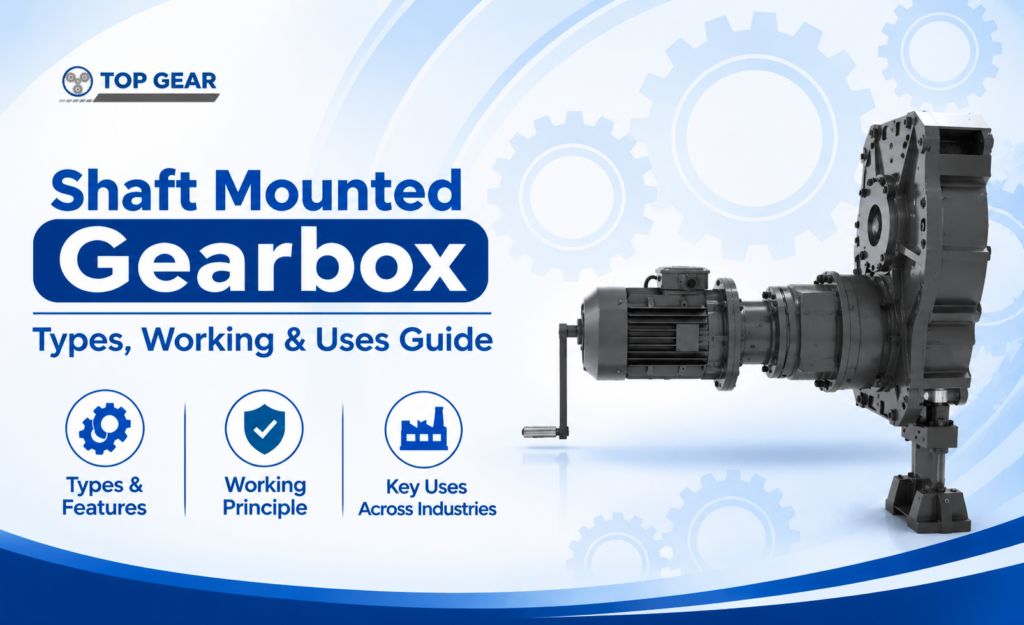
A shaft mounted gearbox removes a part of the usual drive layout. Instead of sitting on its own foundation and connecting to the machine through a coupling, it slides directly onto the driven shaft and is supported by it. That saves space and alignment effort, but it also changes how loads travel through the shaft. This guide explains how the arrangement works, the configurations available and what to tell a manufacturer before asking for a quote.
What a shaft mounted gearbox is
A shaft mounted gearbox has a hollow output shaft, or bore, that fits over the shaft of the driven machine. The driven shaft carries the weight of the gearbox. The motor can be flange-mounted on the gearbox input or placed on a bracket and connected by a belt drive. Because the gearbox can tilt around the driven shaft, a torque arm connects it to a fixed point to resist the reaction torque.
How it works
The motor turns the input shaft, the internal gears reduce the speed and raise the torque, and the hollow output shaft transmits that torque to the driven shaft through a key, a shrink disc or a splined connection. The reaction force of the torque has to go somewhere. In this layout it flows through the torque arm to the supporting structure, so the arm and its anchor must be strong and positioned correctly.
How it differs from a foot-mounted gearbox
A foot-mounted gearbox is bolted to a base, with a coupling between its output and the machine shaft; alignment of the two shafts is critical. A shaft mounted unit needs no coupling or separate base for the gearbox and has no shaft-to-shaft alignment, but it relies on the driven shaft to support it. That makes the strength and rigidity of the driven shaft part of the selection, not a detail.
Main components
- Housing, with the oil reservoir and breather.
- Input shaft and gears, with bearings.
- Hollow output shaft, bored and tolerance-matched to the driven shaft.
- Torque arm and its fixing, which resist the reaction torque.
- Optional backstop to prevent reverse rotation on inclined or loaded drives.
- Optional motor mount and belt drive.
Common configurations
By gearing
Helical shaft mounted units are widely used in conveyor drives. Top Gear Corporation also lists a shaft mounted planetary gearbox, which combines the hollow-shaft mounting with planetary gearing for compact high-torque duties. Worm-gear shaft mounted units exist as well and suit light, low-efficiency-tolerant duties.
By shaft connection
A keyed bore is simple and common. A shrink disc clamps the hollow shaft onto the driven shaft by friction, which can make fitting and removal easier and avoid keyway wear. The choice depends on torque, duty and how often the gearbox is removed.
By drive arrangement
A flange-mounted motor gives a compact package. A belt drive between motor and gearbox allows an additional speed step and some adjustment of the final ratio.
Typical applications
Shaft mounted gearboxes are commonly applied to conveyors, screw feeders, mixers and agitators, and other machines where a gearbox can be fitted straight onto a drive or pulley shaft. They are relevant in material handling, cement and mining plants, among others, wherever space is limited and shaft-to-shaft alignment is difficult to maintain.
Benefits and practical considerations
The benefits are a smaller footprint, no coupling, faster installation and no separate gearbox foundation. The considerations are real: the driven shaft carries an overhung load from the gearbox weight and any belt tension, the torque arm creates a reaction force on the structure, and removing the gearbox from the shaft needs planning, especially after long service when fretting or corrosion may have set in.
Torque, speed and load requirements
Select on the torque at the driven shaft, including starting and peak loads, then apply a service factor suited to the duty. The output speed follows from the motor speed and ratio. Check the driven shaft too: its diameter, material and bearing positions must be suitable for the added overhung load and torque. Do not assume that a shaft bore size matching your shaft is sufficient on its own.
Mounting and alignment
Where shaft-to-shaft alignment is not an issue, the main alignment points are the torque arm and, on belt drives, the pulleys. The torque arm should be fitted so that it takes only the reaction torque and does not bind or push the gearbox sideways. Keep the arm length and anchor stiffness to the manufacturer’s guidance. On a belt drive, align the pulleys and set belt tension within the specified range so that the shaft is not overloaded.
Lubrication and maintenance
Mounting orientation affects oil level, breather position and seal exposure, so state the orientation when ordering. Check oil level and condition on a schedule, keep the breather clear, and inspect the torque arm, its bushings, the fasteners and the shaft connection. Apply anti-seize or the specified compound on the driven shaft to ease later removal. Top Gear Corporation’s customer support page describes its support services.
How to select one and what to tell the manufacturer
Send the following for an accurate quotation:
- Required output torque, with peak and starting values, and output speed.
- Motor power and speed, or the preferred drive arrangement.
- Driven shaft diameter, length available, key or shaft details and material.
- Mounting orientation and the position of the torque arm anchor.
- Duty hours, starts per hour, shock loading and direction of rotation.
- Environment: temperature, dust, moisture.
- Need for a backstop, shrink disc or belt drive.
For foot-mounted, offset-shaft alternatives, see the parallel shaft and bevel helical gearbox range, and use the contact page to discuss your requirement with Top Gear Corporation.
FAQs
How is a shaft mounted gearbox held in place without a foot base?
The hollow output shaft sits on the driven shaft, which carries the gearbox weight. A torque arm connected to a fixed point resists the reaction torque. It should be fitted so it takes the torque only and does not bind the gearbox.
Can I use a shaft mounted gearbox on any shaft diameter?
Only within the bore sizes offered, and the driven shaft must be strong enough for the torque and the overhung load. Bore adapters or bushings may be possible in some cases, so ask the manufacturer.
What is the difference between a keyed bore and a shrink disc connection?
A keyed bore transmits torque through a key. A shrink disc clamps the hollow shaft onto the driven shaft by friction, which can ease installation and removal and avoid keyway wear. The choice depends on torque, duty and maintenance preference.
In what orientation can a shaft mounted gearbox be installed?
That depends on its lubrication design. Orientation affects oil level, breather position and seal exposure, so state the mounting orientation when you order.
Does a shaft mounted gearbox need a coupling?
Not at the driven shaft, because the hollow bore connects directly to it. The motor may be flange-mounted on the gearbox or connected by a belt drive, which is a separate design choice.