

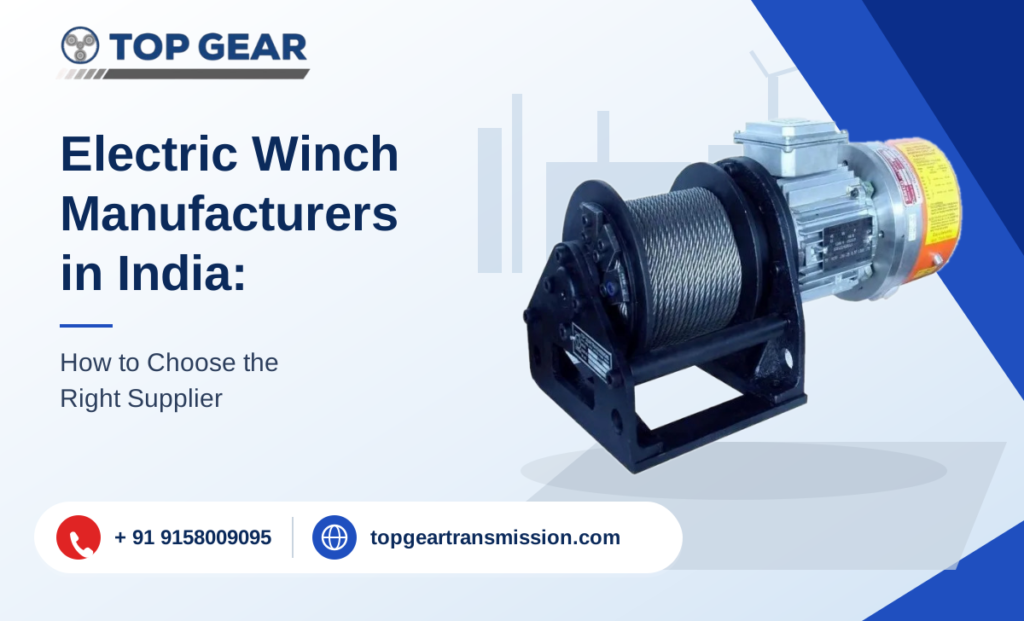
Buying an electric winch looks simple on a quotation: a motor rating, a rope capacity, a line pull figure. Those numbers mean something only when they are tied to your load, your duty and your site. Two suppliers can quote the same line pull and deliver machines that behave very differently after a year of use. This guide shows what to examine, especially in the drive system, and how to compare manufacturers in India on evidence rather than catalogue claims.
How an electric winch works
An electric winch converts electrical power into a controlled pulling or lifting force on a rope. The motor turns fast with modest torque. A gearbox reduces that speed and multiplies torque, and its output turns a drum that winds the rope. A brake holds the load when the motor stops, and a control panel handles starting, stopping, direction and sometimes speed. Each element must suit the others; a strong drum fitted to an undersized gearbox is still an undersized winch.
Where electric winches are used
Electric winches suit sites with a dependable power supply and work that is repetitive or needs careful handling: positioning heavy equipment in plants, hauling material, tensioning and assisting material movement. Conditions vary widely, and a drive that suits an indoor workshop may not suit a dusty outdoor installation. The Top Gear Corporation pages on construction, mining and material handling applications show the environments in which transmission components are expected to work.
Load capacity and application requirements
Define these before approaching any supplier:
- The maximum load, including the extra force from starting, stopping or snatch loading.
- Whether the movement is a vertical lift, a horizontal pull or a pull along an incline. Friction and gradient change the force required.
- The rope speed needed, and whether it must be adjustable.
- The standards and safety factors that apply to your work. Lifting people, or lifting over people, is a regulated area that needs a separate design and compliance review.
Rope or cable requirements
The rope is part of the machine. Its diameter, construction and breaking load must suit the drum groove, the sheaves and the load, with the safety factor your standard demands. The ratio of drum diameter to rope diameter affects rope life, so ask what the design uses. Rated pull normally applies to one layer on the drum and falls as layers build up, because the effective drum diameter grows. Confirm which layer a quoted figure refers to, check that the rope length fits the drum, and agree who supplies and replaces the rope.
Gearbox and drive-system components
The gearbox sets the torque at the drum, the rope speed, how smoothly the load starts and how much space the drive occupies. Planetary arrangements are widely used in winch drives because they fit a high reduction into a compact, coaxial package and share the load across several gears. That is a design characteristic, not a promise about every product, so ask the manufacturer to show how the reduction was worked out for your duty.
Points to check in the drive:
- The output torque rating against the torque your rope load and drum diameter require, with the service factor stated.
- The brake. Do not assume gear reduction will hold a load. Ask which brake holds it, how it is released and how it is tested.
- How the drum is supported, so rope side loads are not carried by the gearbox output.
- The lubrication method and access for checking oil level.
- Whether the motor and gearbox are supplied and tested as one unit.
Top Gear Corporation lists winch drives and planetary gearboxes on its product pages, and its article on winch drives for heavy load applications gives further background on drive choices.
Speed and duty cycle
Duty cycle describes how often and how long the winch runs. A winch used a few times a shift is a different machine from one running continuously within a process. Give the manufacturer the starts per hour, running time per cycle, ambient temperature, and exposure to dust, moisture or washdown. These decide motor thermal sizing, brake selection and sealing. If a variable-frequency drive will control the winch, say so, because it affects motor choice and low-speed behaviour.
Installation and operating considerations
Poor rope spooling causes much avoidable wear. Keep the fleet angle between drum and first sheave within the manufacturer’s limit, and make sure the frame or foundation resists the full line pull without flexing. Confirm limit switches, emergency stop, overload protection and the electrical supply, including cable size and starting current. Ask for written installation and commissioning instructions, and agree who trains the operators.
Maintenance and service support
A winch is a safety-relevant machine and needs scheduled inspection of gearbox oil, brake wear, rope condition, fasteners and electrical contacts. Ask each supplier for maintenance intervals, lubricant grades and a spares list. Top Gear Corporation describes its customer support and service details online; with any supplier, get the service scope in writing.
How to evaluate electric winch manufacturers in India
Price and line pull alone make a weak comparison. Ask every electric winch supplier for the same information:
- A sizing calculation or design basis, not only a model number.
- Drive details: gearbox type, reduction, torque rating and brake type.
- Pre-dispatch testing and the records provided.
- The standards the machine is designed to. Verify any certificate yourself.
- A general arrangement drawing, manual and spares list.
- Lead time, spare parts supply and who attends in case of breakdown.
- References you can contact directly, and a facility visit for larger purchases.
Common mistakes when choosing a supplier
- Comparing quotations on line pull and price alone.
- Sizing for the running load and ignoring starting and snatch loads.
- Assuming the gearbox will hold the load.
- Leaving duty cycle out of the enquiry.
- Overlooking rope layer and fleet angle.
- Postponing the service and spares discussion until after the order.
Before requesting a quotation
Gather the load and rope details, speed, duty, site conditions, power supply, mounting space and control needs, then send them in one enquiry so every supplier quotes against the same brief. To discuss a drive for your winch, use the Top Gear Corporation contact page.
FAQs
What load information do I need before asking for an electric winch quotation?
Share the maximum load, whether the movement is vertical, horizontal or inclined, the required rope speed, rope length and diameter, and how many starts per hour or hours per day the winch will run. Add power supply details and site conditions such as dust, moisture or temperature. The manufacturer uses these to size the motor, gearbox, drum and brake.
Does the gearbox hold the load in an electric winch?
Not reliably. Many gear arrangements can be driven backwards by the load, so a winch normally needs a dedicated brake to hold the load when power is off. Ask the manufacturer which brake is fitted, how it is released and how it should be inspected.
How do I compare two quotations for an electric winch that show the same line pull?
Compare the design basis behind the figure: the rope layer at which the pull is rated, the gearbox torque rating and service factor, the brake type, the duty rating, testing before dispatch and the documentation supplied. A matching headline number can hide very different drives.
Can the same electric winch be used for lifting and pulling?
Not necessarily. Lifting involves vertical loads, stricter safety factors and brake requirements, while pulling along a surface depends on friction and slope. Tell the supplier which duty is intended. Do not use a winch to lift people unless it is designed and approved for that purpose.
What after-sales support should I ask an electric winch manufacturer about?
Ask about installation and commissioning help, a written maintenance schedule, lubricant and spares lists, spare parts availability and lead times, and who attends in case of breakdown. Get the scope of support in writing before placing the order.