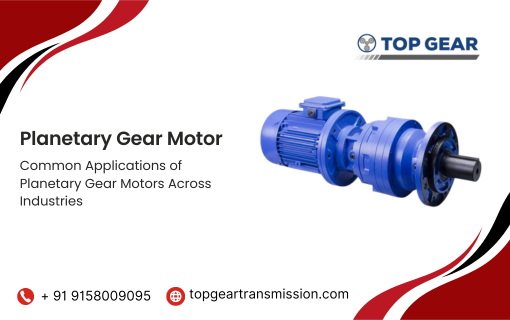

A geared motor combines a motor and a gearbox in one unit. It saves space, cuts installation work, and gives steady power to the machine it drives.
We manufacture planetary geared motors in a modular design for many industrial jobs. This guide explains how they work, their specifications, and where they fit best.
Pumps, mixers, conveyors and cranes all rely on controlled rotation. A geared motor delivers that control while keeping the drive train simple.
What Is a Geared Motor
A geared motor is a self-contained drive. The motor and gearbox are built and supplied as one assembly rather than two separate parts joined on site.
This saves alignment work during installation. It also keeps the drive compact, which matters on machines with limited space around the mounting point.
Our planetary geared motors use IEC motors with ISI standard build and IP55 protection. They run on an S4 class duty cycle at 50 Hz and 440 volts.
Why Choose a Planetary Design
A planetary geared motor spreads the load across several planet gears inside the housing. This gives a high torque to weight ratio in a compact body.
The modular design lets us match the motor, gearbox and mounting to the application. Special geared motors are also available where a standard unit does not fit the job. You can see the full range on our planetary gearbox page.
An electromagnetic brake can be added where the application needs the shaft to hold its position when power is off.
Specifications of Planetary Geared Motors
- Power from 0.17 kW to 75 kW
- Torque capacity from 100 Nm to 1000 kNm
- Speed from 0.02 RPM to 400 RPM
- Mounting in flange, foot or shaft configurations
This range covers small automation drives at one end and heavy material handling drives at the other. Sharing your required torque and speed helps us match the right size quickly.
A wide power band also means one supplier can cover a plant with several different drive needs. This simplifies sourcing and spares planning.
Key Features of Our Geared Motors
- Adaptable to IEC frame motors, with frequency, voltage or special needs met on request
- High torque to weight ratio
- Modular design for flexible configuration
- Backstop arrangement available on request
A backstop arrangement stops the output shaft from rotating backward under load. This suits conveyors and inclined applications where reverse motion could cause damage.
Benefits for Plant Operations
- Motor type and make supplied as per customer requirement
- Individual motors can be replaced if required
- Ease of maintenance
- Rugged construction
- Adaptable for various mounting positions
- Flexible mounting
- Designed for better safety
Being able to replace an individual motor without replacing the gearbox keeps repair costs down over time.
Where Geared Motors Are Used
Machine tool builders use geared motors in plastic machinery, packaging machinery, waste processing machines and brick making machines. Baking and tea making machinery use them too.
Chemical, paint and pharma plants use geared motors to drive agitators, reactor vessels and rotocone blenders. Steady, controlled rotation matters in each of these processes.
Construction equipment makers use geared motors for bar and pipe bending machines and screw conveyors. Power plants use them for ash handling conveyors, coal handling conveyors, rotary air lock valves and travelling grates.
Material handling systems use geared motors across screw feeders, belt conveyors, bottle conveyors and iron ore handling conveyors. Food and grain facilities use them in elevators, and textile plants use them in drum washers.
Geared Motors in Automation Systems
Industrial automation depends on steady, quiet power delivery. A geared motor supports this by keeping speed stable under changing load.
This stability improves performance in robotics, packaging lines and material handling systems. Lower noise output also helps meet factory floor standards.
Precise speed control also reduces wear on downstream components. A steady drive protects belts, chains and bearings connected to it.
How to Choose the Right Geared Motor
Start with the torque and speed your application needs. Then check the available power supply against our 0.17 kW to 75 kW range.
Consider your environment next. Heat, moisture, and dust all affect motor choice and enclosure rating. Our team reviews these factors for every enquiry, the same way we size our winch drives for each job.
Finally, confirm the mounting position your machine needs. Flange, foot and shaft mounting options are all available, so the motor fits your frame without extra fabrication.
Operating in Harsh Conditions
Some sites run hot, wet or dusty all year. A geared motor built with tough enclosures and durable seals keeps working through these conditions.
IP55 protection on our standard range already guards against dust and water jets. For more demanding sites, we can discuss additional sealing and coating options.
Correct enclosure selection at the start avoids costly retrofits later. It is easier to specify the right protection than to add it after installation.
Extending the Life of a Geared Motor
Correct lubrication is the single biggest factor in gearbox life. Follow the recommended oil type and change interval for your model.
Avoid running the motor beyond its rated load and speed. Overloading raises heat and accelerates wear on gears and bearings.
Routine checks for noise, vibration and leaks catch small issues before they grow. You can see how correctly sized drives perform over time in our success stories.
A simple maintenance log, updated at each inspection, makes long-term patterns easier to spot and act on.
Conclusion
A geared motor brings the motor and gearbox together in one reliable unit. A planetary design adds high torque in a compact size, which suits everything from packaging lines to heavy conveyors.
Top Gear Corporation Limited has built gearboxes and geared motors for more than 25 years. To find the right geared motor for your application, visit www.topgeartransmission.com or write to sales@topgeartransmission.com.
Frequently Asked Questions
What is a geared motor?
It is a self-contained drive that combines an electric motor and a gearbox in one assembly.
Why use a planetary geared motor instead of a standard motor?
A planetary design gives a high torque to weight ratio in a compact body, with minimal gear backlash.
What power range do planetary geared motors cover?
Our range covers 0.17 kW to 75 kW, with torque from 100 Nm to 1000 kNm.
What protection rating do these motors carry?
They carry IP55 protection and follow ISI standard build with an S4 class duty cycle.
Can a geared motor include a brake?
Yes. An electromagnetic brake can be added where the application needs the shaft to hold position.
What mounting options are available?
Flange, foot and shaft mounting are all available to match different machine frames.
Which industries use geared motors?
Machine tools, chemical and pharma plants, construction equipment, power plants, and material handling all use them.
What is a backstop arrangement?
It stops the output shaft from rotating backward under load, useful on conveyors and inclines.
How do I choose the right geared motor size?
Match your torque, speed and power needs first, then confirm the mounting position and environment.
Can geared motors work in hot or wet conditions?
Yes. Tough enclosures and IP55 protection allow reliable operation in harsh industrial settings.
How can I extend the life of a geared motor?
Follow the correct lubrication schedule, avoid overloading, and carry out routine noise and leak checks.
Can individual motors be replaced without changing the gearbox?
Yes. The modular design allows the motor to be replaced separately if required.