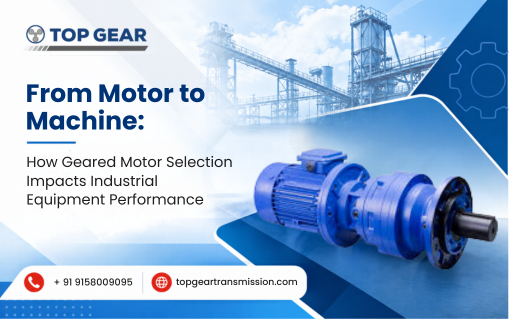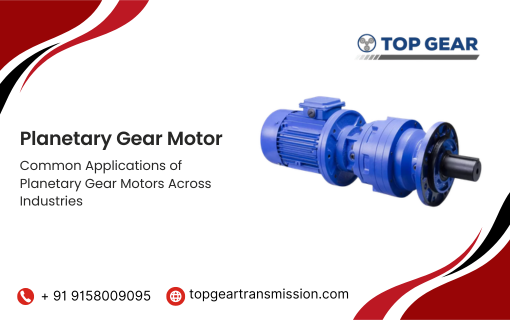

A geared motor sits at the start of almost every industrial machine. It turns electrical power into controlled torque and speed at the machine shaft. Every component downstream depends on what it delivers.
Geared motor selection looks like a catalogue task, but it shapes industrial equipment performance for years. A well chosen unit runs cool, stays quiet and protects the machine it drives. A poorly chosen unit shows up later as heat, noise and unplanned stops.
At Top Gear Transmission, we size drives for plants every week. This guide explains how selection choices change output, reliability and running cost. For the basics of how a geared motor is built, read our earlier post on choosing a geared motor for reliable industrial drives.
What Geared Motor Selection Actually Decides
A geared motor is a motor and gearbox supplied as one drive unit. Selection fixes four outcomes on the machine. These are output torque, output speed, thermal behaviour and service life.
Output torque decides whether the machine starts and holds its load. Output speed decides throughput. Thermal behaviour decides how long the oil and seals last. Service life decides how often the plant stops for repair.
These four outcomes are linked. A change in ratio moves torque and speed at the same time. A change in load moves heat and wear at the same time. Selection is therefore a balancing task and not a single number on a datasheet.
Start With the Load and Not the Motor
The driven machine sets the requirement, and the motor rating follows from it. Many sizing errors begin when a motor power is picked first and a gearbox is fitted around it afterwards.
Begin with the load torque at the output shaft. Note the peak torque during starting, the steady running torque and any torque spikes. Peak values often sit well above running values on conveyors, mixers and crushers.
Next, record the required output speed and the direction of rotation. Then note how many times the machine starts and stops each hour. Frequent starts add heat that a steady running figure will never show.
Our planetary geared motor range serves small automation drives and heavy material handling drives alike. Once the load data is clear, the right frame size is usually easy to identify.
Service Factor and Duty Cycle
Service factor is a multiplier applied to the load to reflect how the machine behaves. A smooth and steady load gets a low factor. A load with shocks or reversals gets a higher one.
Standard gear practice groups loads into uniform, moderate shock and heavy shock classes. Commonly used service factors rise from around one for uniform loads to near two for heavy shock. The exact value also depends on the gearbox type and the running hours per day.
Duty cycle describes how the drive runs over time. A drive running continuously needs a different thermal rating from one that runs in short bursts. Continuous running at full load is the harshest case for oil temperature.
Skipping the service factor is one of the most common causes of early gear failure. The gearbox may carry the rated torque on paper. Shock loads then push contact stress past the design limit, and the teeth begin to pit or break.
Duty class affects the motor as well. Intermittent duty classes such as S4 describe motors built for frequent starts, and they suit drives that cycle often.
Torque, Speed and Ratio
Gear ratio converts motor speed into output speed and multiplies torque by roughly the same factor, less losses. A four pole motor runs near 1440 rpm on a 50 Hz supply. A ratio of 20 to 1 therefore gives close to 72 rpm at the output shaft.
Higher ratios give more torque and lower speed. They also raise the torque that the final gear stage must carry. A ratio chosen only to hit a speed target can leave the output stage too small for the real load.
Planetary designs share torque across several planet gears, which keeps the unit compact at high torque. Where the output speed is very low, a multi stage planetary drive reaches it without a bulky housing.
Variable frequency drives widen the speed range of a geared motor, and they bring their own checks. A standard motor at low frequency gets less cooling air from its fan. Long periods at low speed can overheat the winding unless the motor is rated for that duty.
Efficiency and Thermal Behaviour
Every gear stage loses some power as heat. Helical and planetary stages typically lose a few percent per stage. Worm stages lose more, and the loss rises as the ratio goes up.
Losses matter for two reasons. They raise the running cost across thousands of operating hours each year. They also heat the oil, and oil life falls quickly as temperature climbs.
A gearbox that runs near its thermal limit needs a larger frame, better cooling or a different gear type. Moving up one frame size costs little when compared with replacing a drive that keeps overheating.
Ambient temperature, ventilation and dust on the casing all change the thermal rating. Catalogue ratings assume stated conditions, so site conditions should always be checked against them.
Shaft Loads, Mounting and Lubrication
The output shaft carries more than torque. Belts, chains and pinions pull sideways on it. This sideways force is called overhung load, and it acts directly on the output bearing.
Selection should compare the real overhung load and its distance from the bearing with the permitted value. Exceeding the permitted value shortens bearing life and can bend the shaft.
Mounting position changes lubrication. Oil level and splash paths differ between horizontal, vertical and inclined mounting. Share the mounting position when you place the order so that oil quantity and breather position are set correctly.
Flange, foot and shaft mounting each carry loads in a different way. Choose the one that fits the machine frame without extra fabrication.
Brakes, Backstops and Control Compatibility
Some machines must hold position when power is cut. A brake on the motor handles this task. Inclined conveyors need a backstop so that the load cannot run backward.
Control equipment shapes selection too. A drive on a variable frequency inverter needs a motor and gearbox rated for the speed range and for the torque at low speed. Soft starters reduce shock at start up and lower the stress on gear teeth.
Raising these points before ordering avoids add-on fittings and rework later.
What Poor Selection Costs a Plant
Undersizing shows up as heat, noise and early wear. Oversizing shows up as higher purchase cost, a larger footprint and poor efficiency at light load. Both choices reduce industrial equipment performance.
Downtime is the largest cost. A failed gearbox on a conveyor or mixer stops the whole line. Replacement also takes time, because mounting and alignment must be repeated.
Maintenance cost rises as well. Drives that run hot need more frequent oil changes. Drives under shock load need more frequent bearing checks. A correct selection lowers both.
Our success stories page shows how correctly sized drives perform in service. For examples of sectors that rely on these drives, see our post on common applications of planetary gear motors across industries.
A Practical Selection Checklist
Collect these inputs before requesting a quote. You will need the output torque, the peak torque and the required output speed. Add the running hours per day and the number of starts per hour.
Describe the shock level of the load and the ambient temperature. Note any dust or water exposure. Record the mounting position and the shaft loads. Finally, state the supply voltage and frequency and mention any inverter use.
With these inputs in hand, a supplier can check torque, thermal rating and shaft loads in one review. You can also begin with the calculator on our website. Drives for industrial automation and material handling both follow this same process.
How Top Gear Transmission Supports Selection
We review torque, speed, duty and environment for every enquiry. We also supply special geared motors where a standard unit does not fit the job.
Send your load data to sales@topgeartransmission.com or call +91-2162-240642. Our engineers will propose a drive that matches your machine and your duty.
Frequently Asked Questions
What is geared motor selection?
Geared motor selection is the process of matching a motor and gearbox to the torque, speed, duty and environment of a driven machine.
Why does geared motor selection affect equipment performance?
Selection fixes output torque, speed, heat and service life. A mismatch causes overheating, early wear and unplanned stops.
What is a service factor in a geared motor?
A service factor is a multiplier applied to the load to account for shocks, reversals and running hours. Heavier loads need a higher factor.
How does duty cycle affect geared motor choice?
Duty cycle sets the thermal load on the oil and winding. Continuous running needs a higher thermal rating than short, intermittent running.
What happens if a geared motor is undersized?
An undersized unit runs hot and wears quickly. Gear teeth and bearings carry stress beyond their design limits and fail early.